
What Healthcare Can Learn from How Patients Rate Experiences Like Uber

.png)
Patient Expectations Have Already Changed
Patients now expect the same level of clarity, speed, and convenience they experience in every other part of their lives. Digital platforms have trained consumers to expect real time updates, simple transactions, and full visibility into outcomes.
Healthcare organizations are now being evaluated through that same lens, especially when it comes to financial experience.
For executives, this shift is already impacting performance across key metrics including patient satisfaction, cost to collect, and revenue cycle efficiency.
The revenue cycle has become one of the most important drivers of overall patient perception.
The Revenue Cycle Shapes the Patient Experience
The financial journey is one of the most frequent and emotionally sensitive touchpoints patients have with a healthcare organization.
Every interaction carries weight:
- Insurance verification before care
- Prior authorization processes
- Cost estimates and financial responsibility
- Billing clarity and timing
- Payment options and resolution workflows
When these processes break down, patients experience confusion, frustration, and delays. Those experiences influence whether they trust the organization, return for future care, or pay in a timely manner.
Operational inefficiencies quickly become experience failures.
Why the Uber Comparison Resonates
Platforms like Uber set a clear standard for how modern experiences should function.
Users receive immediate visibility into:
- Status updates in real time
- Exact timing expectations
- Clear pricing before commitment
- Seamless payment workflows
These elements reduce uncertainty and build confidence.
In contrast, many healthcare revenue cycle processes still rely on disconnected systems, manual work, and delayed communication. Patients often move through the financial journey without clear answers or consistent updates.
That lack of visibility creates friction at every stage of the experience.
For executives, this gap translates into missed revenue opportunities, higher operational costs, and lower patient satisfaction scores.
The Root Cause: Fragmented Workflows
Most healthcare organizations have invested heavily in core systems such as electronic health records, practice management platforms, and payer connectivity tools.
The challenge sits between those systems.
Revenue cycle workflows often require teams to:
- Navigate multiple platforms to complete a single task
- Manually transfer data between systems
- Follow up across payer portals for updates
- Reconcile inconsistencies across records
This environment creates delays, increases error rates, and limits scalability.
Teams spend time managing processes instead of improving outcomes.
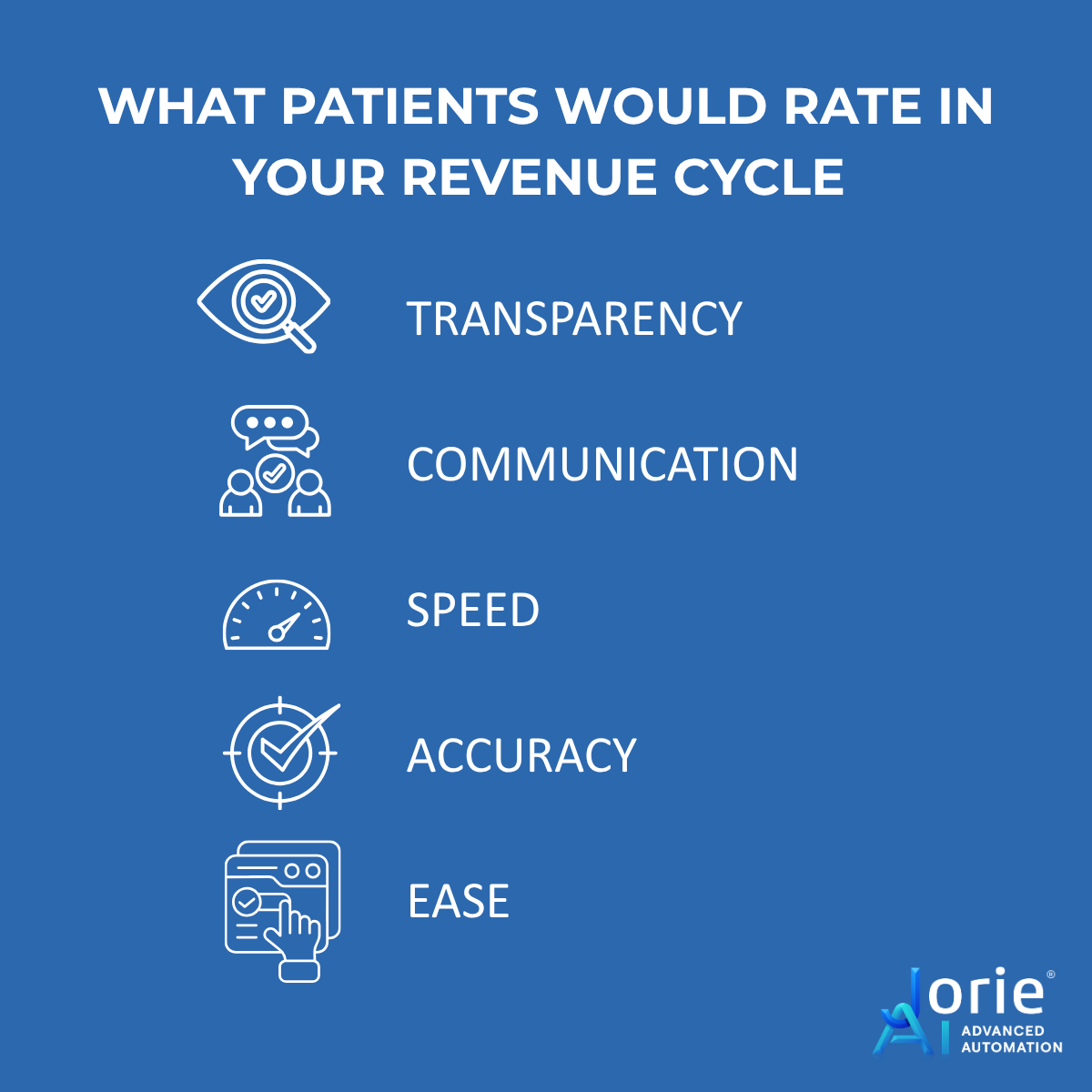
What Patients Would Rate in Your Revenue Cycle
If patients evaluated the financial experience the same way they rate consumer platforms, their feedback would center on five areas:
Transparency Clear understanding of costs before services are delivered
Communication Consistent updates throughout the financial journey
Speed Timely resolution of billing questions and claims
Accuracy Confidence that bills are correct and consistent
Ease Simple, intuitive payment and support processes
Each of these areas directly connects to operational performance inside the revenue cycle.
The Financial Impact of Experience Gaps
Revenue cycle inefficiencies create measurable business challenges:
- Higher denial rates due to incomplete or inconsistent data
- Increased cost to collect driven by manual rework
- Slower cash flow tied to delayed billing and follow up
- Elevated call center volume from patient confusion
- Lower patient retention and lifetime value
Why Traditional Fixes Fall Short
Adding more tools or increasing staffing levels rarely solves the underlying problem.
Disconnected systems continue to create gaps. Manual workflows continue to introduce delays and errors. Teams remain reactive instead of proactive.
Sustainable improvement requires coordination across the entire revenue cycle.
That coordination must happen in real time and at scale.

Jorie AI: A New Approach to Revenue Cycle Performance
Jorie AI connects systems, automates workflows, and removes the manual steps that slow down revenue cycle operations.
It acts as an orchestration layer across existing technology investments, allowing organizations to maximize the value of the systems they already have.
Key capabilities include:
Workflow Automation Across the Revenue Cycle Automates eligibility verification, prior authorization tracking, claim status checks, and follow up processes
Real Time Operational Visibility Provides insight into workflow status, bottlenecks, and performance metrics across teams and systems
Data Synchronization Maintains consistency across platforms, reducing errors and eliminating redundant work
Faster Throughput Accelerates task completion and reduces delays across the revenue cycle
Improved Patient Financial Experience Delivers clearer communication, fewer errors, and more predictable outcomes for patients
What a Modern Revenue Cycle Experience Looks Like
- Patients receive accurate cost expectations before care
- Insurance verification and authorizations progress without manual intervention
- Billing occurs on time with clear, consistent information
- Questions are resolved quickly with minimal back and forth
- Payments are easy to complete without friction
These improvements strengthen both operational performance and patient trust.
A Strategic Priority for Healthcare Executives
Revenue cycle transformation is no longer a back office initiative. It directly impacts growth, efficiency, and patient loyalty.
Organizations that invest in workflow orchestration and automation gain:
- Stronger financial performance
- Lower administrative burden
- Higher patient satisfaction
- Greater scalability across operations
Leaders who take action now position their organizations to meet rising expectations while maintaining control over costs and complexity.
Turning Expectations into Advantage
Patient expectations will continue to rise as digital experiences evolve across industries.
Healthcare organizations that deliver clarity, speed, and consistency within the revenue cycle gain a meaningful competitive advantage.
Healthcare leaders have a clear opportunity to improve both financial performance and patient experience through smarter revenue cycle operations.
See how Jorie AI can help your organization reduce inefficiencies, accelerate cash flow, and deliver the transparency patients expect.
Request a demo today and take the next step toward a more connected, high performing revenue cycle.
Follow Jorie AI on Instagram: Instagram
Follow Jorie AI on Tiktok: Tiktok
Follow Jorie AI on LinkedIn: LinkedIn
Keep reading
Explore more insights from our team

Jorie Tech Talks Podcast - The Jorie Story EP 1
Tune in to the Jorie Tech Talks Podcast. Were we chat some of the most influential people in healthcare.

Jorie Leads Revenue Cycle AI Transformation w/ Sal Lo
Discover how Sal Lo leads the transformation of revenue cycle management with AI at Jorie.

What Patients Do Not See: How Back Office Inefficiencies Impact the Care Experience
Administrative inefficiencies in hospitals affect patient care, billing, and staff. See how Jorie AI streamlines workflows to improve the patient experience.
-p-800.png)
When Claims Disappear: Solving Healthcare’s Silent Revenue Leak
In this new blog, we break down a silent threat to revenue cycle performance, and how Jorie AI is helping healthcare teams find and recover the dollars hiding in plain sight.
.png)
Revenue Cycle Benchmarking: How to Assess Your Performance
Discover how to assess and enhance your healthcare organization's revenue cycle management with effective benchmarking. Learn key metrics and strategies to improve efficiency, reduce costs, and ensure better financial health for the new year.
.png)
Simplifying Healthcare Operations in 2025
Discover how Jorie AI is simplifying healthcare operations in 2025. From automating revenue cycle management to securing sensitive data, learn how AI can help healthcare providers optimize processes and improve patient care.
-p-800.png)
The True Cost of Physician Burnout
Physician burnout is costing healthcare more than we realize. Explore how AI and automation are reducing administrative burdens and helping providers refocus on patient care.

Improving the Patient Financial Experience with AI: Why It Matters for Healthcare Executives
Improving the patient financial experience is essential for healthcare executives focused on revenue, retention, and patient satisfaction. Jorie AI streamlines billing, automates revenue cycle tasks, and delivers personalized, error-free interactions for patients.
.png)
Maximizing ROI: Measuring the Financial Gains of RCM Investments
Discover how healthcare organizations can maximize ROI from RCM system investments. Learn to measure financial impacts, enhance revenue collection, reduce costs, and streamline operations with actionable insights.
-p-800.png)
The Hidden Cost of Staff Turnover in Healthcare Revenue Operations
High staff turnover in healthcare revenue cycle teams can slow claims, increase errors, and drain revenue. Jorie AI’s AI-driven automation maintains workflow continuity, reduces delays, and helps hospitals stay financially stable even during transitions.
-p-800.png)
Claims Processing Automation - Transform Workflows Fast
Claims processing automation reduces manual errors and speeds up approvals. Discover how automation transforms workflows for faster, more accurate claims. Learn more inside.
.png)
Did You Know AI Could Revolutionize Your Healthcare Billing?
AI automation is reshaping medical billing workflows, enhancing efficiency and accuracy. Learn how Jorie AI’s advanced solutions help reduce errors, speed up claims processing, and optimize revenue cycle management, driving cost savings and improved financial performance for healthcare providers worldwide.
-p-800.png)
How Machine Learning Reduces Human Error in Healthcare Finance
Human error in healthcare finance isn’t inevitable. Strategic AI and machine learning solutions are helping organizations eliminate mistakes, reduce risk, and drive better revenue outcomes across the healthcare revenue cycle.
-p-800.png)
A Season of Gratitude, Growth, and Looking Ahead
Jorie AI reflects on a year of impact, collaboration, and innovation in healthcare automation, sharing gratitude for clients, partners, and teams this Christmas Eve.
.png)
8 Signs It’s Time to Upgrade Your Revenue Management Solutions
Many healthcare providers overlook key signs that their revenue management software is failing them. Spot the red flags—and see how Jorie AI turns those challenges into real results.

Communication in AI: Why Human Interaction is Crucial for Success
Effective AI-driven revenue cycle management goes beyond automation. Successful implementation requires continuous communication and human guidance. Learn how Jorie AI ensures seamless collaboration with healthcare organizations to optimize AI solutions and maximize financial outcomes.
.png)
Cutting Losses with AI
AI is transforming how healthcare organizations cut hidden costs and optimize operations. By uncovering inefficiencies and streamlining workflows, Jorie AI helps drive continuous improvement, resulting in long-term savings and operational success.
%20(1).png)
Utilizing AI for Effective Claims Processing in Healthcare
Revolutionize claims processing in healthcare with AI-driven solutions. Learn how automation enhances accuracy, reduces denial rates, and accelerates payment cycles, transforming the revenue cycle for better financial outcomes.
-p-800.png)
Healthcare Revenue Cycle KPIs: What to Measure and Why
A practical guide to healthcare revenue cycle KPIs explaining what to measure, common challenges, best practices, and how technology improves KPI tracking and outcomes.

Quiet Strategy- Why Jorie AI Doesn't Advertise Its Wins- But Might Start
Jorie AI’s approach to healthcare automation has prioritized outcomes over promotion. Explore why a quiet strategy helped drive success in AI automation in healthcare, RCM billing, and revenue cycle AI—and why that may be evolving.
%20(13).png)
Tackling Denials with Smart Learning Tools
Smart learning tools powered by AI are transforming healthcare revenue cycle management by reducing denials, improving payment reconciliation, and streamlining appeals. See how Jorie AI helps healthcare organizations strengthen their revenue cycle.
.png)
Data-Driven Insights for Strategic RCM Planning
Unlock the power of data-driven insights in revenue cycle management (RCM). Discover how advanced analytics and AI optimize financial operations, enhance decision-making, and improve patient care for healthcare organizations.
-p-800.png)
Beyond Automation: How AI Can Transform Healthcare Decision Intelligence
AI-driven decision intelligence transforms healthcare leadership by turning complex data into actionable insights. Executives can make smarter, data-backed decisions that improve patient care and operational efficiency.
.png)
The Rise of AI Automation in Fintech: What Healthcare Can Learn
AI automation is revolutionizing fintech and healthcare by streamlining processes, enhancing decision-making, and driving innovation. Learn how these technologies are shaping the future of these industries.
-p-800.png)
Trust at the Core: How AI and Billing Transparency Strengthen Patient Relationships
Confusing medical bills erode patient trust and delay payments. Jorie AI brings clarity and transparency with AI-powered automation, helping hospitals improve both revenue and patient relationships.
-p-800.png)
Why “Frankenstein” RCM Systems Are Failing Healthcare Leaders
Many health systems rely on a patchwork of RCM tools that create silos, errors, and revenue leakage. Discover how Jorie AI replaces the ‘Frankenstein Effect’ with real-time intelligence, denial prevention, and cleaner claim data—integrating seamlessly with Epic, Cerner, and more.
.png)
Transforming Healthcare Revenue Cycle Management with Jorie AI
Discover the journey of Jorie AI, from its healthcare roots to leading the charge in revenue cycle management automation. Learn how our AI-powered platform simplifies billing, reduces costs, and improves financial outcomes for healthcare providers.
.png)
Smarter Operations: Scaling Healthcare with AI Innovation
AI automation is transforming healthcare, driving smarter operations and scalable growth. Learn how AI automation software is reshaping healthcare billing, clinical decision-making, and operational workflows.
.png)
Healthcare Revenue Cycle Optimization: Tips for Success
Optimize your healthcare revenue cycle with expert tips and strategies. Learn about AI-driven revenue cycle solutions, analytics, consulting, and outsourcing to enhance performance and streamline processes.
-p-800.png)
When Doctors Called Formula 1: What Pit Stop Precision Taught Healthcare and How It Reflects Jorie’s Mission
When two London doctors turned to Formula 1 pit crews for help, they redefined how hospitals approach teamwork and precision. Jorie AI brings that same philosophy to the revenue cycle, creating faster, smarter, and more coordinated healthcare operations.
-p-800.png)
AI as a Teammate, Not a Tool: Rethinking Human Machine Collaboration in Hospitals
AI works best when treated as a teammate, not just a tool. Jorie AI helps hospitals build trust, improve workflows, and empower staff.
-p-800.png)
The AI Talent Crunch in Healthcare: Why Upskilling Beats Hiring
Healthcare faces a growing AI talent gap, with workforce shortages blocking adoption. Jorie AI empowers existing staff with automation and real-time insights, eliminating the need for costly new hires.
.png)
Six Questions Shaping the Future of AI in RCM
AI in revenue cycle management (RCM) is transforming how healthcare organizations tackle claim denials, streamline processes, and boost financial outcomes. Learn how AI-driven solutions predict denials and accelerate claims management for improved efficiency.
%20(14).png)
Common RCM Billing Challenges and Solutions
Managing the healthcare revenue cycle comes with challenges like claim denials, underpayments, and rising costs. See how AI-driven RCM solutions can streamline billing, reduce errors, and improve cash flow.
.png)
AI vs. Your Coffee Addiction: Which One’s More Energizing?
Discover how AI in revenue cycle management is transforming healthcare organizations. Learn how artificial intelligence in RCM boosts efficiency, reduces errors, and ensures long-term financial success in revenue cycle automation.
.png)
Think Your System is Fully Optimized? Think Again with AI Insights
Unlock the hidden potential in your healthcare systems with AI. Learn how automation and real-time insights transform revenue cycle operations, reduce inefficiencies, and improve financial outcomes.
-p-800.png)
Introducing SmartCore Engine
SmartCore Engine powered by Jorie AI is redefining healthcare automation. Built to connect systems, not replace them, it unites human expertise, robotic process automation, and generative AI to streamline operations, reduce costs, and improve visibility across the healthcare network.
-p-800.png)
The Invisible Backbone: Why Healthcare Resilience Starts With the Right Revenue Infrastructure
Jorie AI quietly reinforces the healthcare revenue cycle by ensuring real-time operational stability, even when legacy systems fail. Learn how it reduces manual work, prevents denials, and keeps revenue flowing with minimal disruption.
-p-800.png)
Would Healthcare Survive Without AI? A Thought Experiment
A thought experiment on healthcare without AI. See why automation and predictive insights are becoming essential for hospital survival.
%20(9).png)
Legacy Systems Are Holding Hospitals Back: How AI Enhances Patient Care and Reduces Costs
Legacy healthcare systems are slowing hospitals down, increasing costs, and impacting patient care. Discover how AI-driven solutions improve efficiency, optimize revenue cycle management, and enhance patient outcomes.
.png)
Prior Authorization Denials Reduced to 0.21%: How RPA is Transforming Healthcare
Streamline prior authorizations with RPA. See how Jorie AI helped a rural hospital reduce denials to 0.21% and boost cash flow by $2.28M with AI-driven automation.
%20(8).png)
How Automation is Transforming Healthcare Administration
Healthcare organizations are under increasing administrative strain, but automation is transforming efficiency. From AI-driven revenue cycle management to automated patient flow systems, discover how technology is reducing costs, minimizing errors, and allowing providers to focus more on patient care.
-p-800.png)
Harnessing AI to Support Breast Cancer Care: How Jorie Helps Hospitals Deliver Better Outcomes
Jorie AI helps hospitals streamline administrative workflows to support timely, coordinated breast cancer care. By automating revenue cycle tasks and reducing staff burden, Jorie enables clinicians to focus on improving patient outcomes and experiences.
-p-800.png)
Trustworthy AI in Healthcare Finance: Why Explainability Matters More Than Ever
Explainability is key to building trust in AI-driven healthcare finance. Jorie AI delivers transparent, data-backed insights that help leaders make confident, informed decisions across revenue cycle operations.
-p-800.png)
Inside the Rise of the Autonomous Pharmacy
Autonomous pharmacy systems are bringing automation and AI to the world of medication management. Here’s how they work—and what they reveal about the future of healthcare operations.
-p-800.png)
AI-Enhanced Collaboration: How Intelligent Insights Bring Revenue Cycle Teams Together
Jorie AI enhances collaboration in healthcare revenue cycle management by providing clear, explainable insights. Teams can align on priorities, reduce errors, and make confident, data-driven financial decisions.
-p-800.png)
A Day in the Life of a Patient: With Jorie AI vs Without Jorie AI
Administrative delays can frustrate patients and overwhelm hospital staff. Jorie AI streamlines verification and claims processes, allowing staff to focus on care and giving patients a smoother, more confident experience.

Revolutionizing Revenue Cycle at a Regional Hospital District
A regional hospital district partnered with Jorie AI to modernize its revenue cycle through intelligent automation, achieving a 19 percent improvement in A/R performance, $4.9 million in financial gains, and record low denial rates while improving efficiency and strengthening financial stability.
-p-800.png)
Revenue Cycle Resilience: Preparing Health Systems for Unexpected Surges and Challenges
Unexpected surges and challenges can disrupt the revenue cycle, impacting both financial performance and patient experience. Automation and real-time insights help health systems stay resilient, maintain accuracy, and keep processes running smoothly.
-p-800.png)
Revenue Cycle and Environmental Sustainability: How Streamlining Processes Supports a Greener Healthcare System
Streamlining revenue cycle processes can reduce paper use, energy consumption, and administrative waste in healthcare. Automation and intelligent workflows improve efficiency while supporting environmental sustainability and operational performance.
%20(2).png)
AI and the Future of Patient-Centered Care
Discover how AI automation is revolutionizing patient-centered care by enhancing engagement, personalizing treatments, and optimizing revenue cycle management. Explore the future of healthcare with AI-driven solutions.

Revolutionizing Revenue Cycle: The Jorie AI Impact on a Rural Healthcare System
A rural health system partnered with Jorie AI to automate its revenue cycle, reducing days in A/R by 3, increasing collections by $4.4M, and freeing $820K in working capital. See how automation improved efficiency, reduced denials, and strengthened financial performance.
-p-800.png)
Get Paid Faster with AI-Optimized Dermatology Revenue Cycle Management
Discover AI-powered dermatology revenue cycle management that boosts efficiency, reduces claim rejections, and accelerates reimbursements for your clinic.
-p-800.png)
When Efficiency Meets Empathy: The Human Side of Healthcare Automation
Automation in healthcare can enhance efficiency while preserving the human touch. Learn how thoughtful workflows allow staff to focus on patients and deliver better outcomes.
-p-800.png)
11 Best Medical Billing and Coding Software Compared
Find out what makes the best medical billing and coding software essential for healthcare practices and how it supports compliance, efficiency, and accuracy.

The Role of Gratitude in Building Better Healthcare This Thanksgiving
This Thanksgiving, see how gratitude can inspire healthcare teams and strengthen connections across the workplace. Jorie helps organizations streamline workflows so staff can focus on what truly matters

Building Value the Right Way: What Sets Jorie AI Apart
Inside one of the most talked-about healthcare automation companies: how Jorie AI delivers value through real execution—not speculation.
%20(5).png)
Tailoring Revenue Cycle Management Systems to Meet Unique Organizational Needs
Discover how customizable RCM systems can transform healthcare revenue cycle management by improving efficiency, reducing claim denials, and meeting unique organizational needs. Learn how tailored AI-driven solutions empower providers to optimize financial and operational performance.
-p-800.png)
Lost Time, Lost Revenue: The Real Impact of Delays in the Revenue Cycle
Delays in revenue cycle decisions cost hospitals time, money, and patient trust. Real-time verification and automation streamline processes while improving financial and operational outcomes.
.png)
Discover the Untapped Potential of AI in Healthcare Billing
Maximize your healthcare billing efficiency with AI automation. Streamline operations, reduce errors, and uncover hidden revenue opportunities with cutting-edge solutions from Jorie AI.
-p-800.png)
The Human Side of Automation: How AI Can Free Staff to Focus on Patient Care
Administrative tasks can pull healthcare staff away from patient care, increasing stress and errors. Automation and AI allow teams to focus on meaningful work while improving accuracy, efficiency, and patient experience.
%20(7).png)
How AI and IoT Are Revolutionizing Healthcare Operations and Revenue Cycle Management
AI and IoT are transforming healthcare, from automating revenue cycle management to enhancing cybersecurity and predictive maintenance. Explore how these technologies are optimizing operations, reducing costs, and improving financial accuracy in hospitals.
-p-800.png)
Common Denial Reason Codes in Medical Billing and How to Solve Them with AI
Common medical billing denial codes cause revenue delays and administrative strain. AI and automation from Jorie AI help identify, prevent, and resolve denials in real time to improve RCM performance.
.png)
Demystifying RPA: A Comprehensive Guide to Robotic Process Automation in Healthcare
Robotic Process Automation (RPA) is transforming healthcare operations by automating repetitive tasks and improving efficiency. This guide explores how RPA is reshaping healthcare systems, from streamlining billing to enhancing patient care, and highlights its critical role in revenue cycle management.
-p-800.png)
When Healthcare Operations Become Invisible and Why That Is the Goal
Jorie AI redefines healthcare operations by removing friction, aligning workflows, and creating intelligent systems that work quietly in the background.
-p-800.png)
What the 'One Big Beautiful Bill' Means for Healthcare Providers
The One Big Beautiful Bill is reshaping Medicaid, documentation compliance, and healthcare operations. Learn what it means for providers, how to prepare, and why automation is key to resilience.
-p-800.png)
The ROI of Internal AI Training
AI in healthcare isn’t just about tools—it’s about the people trained to use them. Learn why internal AI training delivers long-term ROI and builds smarter, more resilient teams.

How Can the Revenue Cycle Be Improved in Healthcare?
Healthcare revenue cycle improvement isn't just a buzzword. Break down each step, the real challenges, and how automation makes lasting impact.

Making Waves at ViVE 2025: AI in Healthcare & Revenue Cycle Transformation
Join Jorie AI at ViVE 2025 in Nashville to explore AI automation in healthcare and revenue cycle management technology. Visit our booth, attend CEO Sal Lo’s presentation on AI’s ROI, and book a live demo to see automation in action.
-p-800.png)
Beyond the Numbers: Building Financial Intelligence Across the Revenue Cycle
Revenue cycle management is more than managing claims and collections. Healthcare organizations can leverage operational data to generate actionable insights that improve financial performance and enhance patient care.
-p-800.png)
Why Now Is the Time to Embrace AI and Automation
Hospitals are facing shrinking margins, cybersecurity risks, and workforce strain. Here's why embracing AI and automation in revenue cycle operations isn't optional anymore—it's urgent.
.png)
Top Healthcare AI Trends and Solutions to Watch in 2025
Discover the top healthcare AI trends to watch in 2025! From AI-powered revenue cycle automation to personalized patient care and predictive analytics, explore the key innovations transforming healthcare operations, patient experiences, and financial processes.
-p-800.png)
7 Best Healthcare Financial Software for Hospitals & Clinics
Discover the features, benefits, and trends shaping healthcare financial software. Learn how it streamlines billing, compliance, and revenue management.
%20(6).png)
Navigating Payer Complexity: Strategies for Managing Multiple Contracts in RCM Systems
Managing multiple payer contracts is a challenge for healthcare organizations. This guide explores key strategies for simplifying payer complexity with AI-driven RCM automation.
%20(15).png)
How Jorie AI Transformed an Orthopedic Practice
Discover how Jorie AI transformed an orthopedic practice struggling with staff shortages, rising claim denials, and revenue leakage. Learn how AI-driven automation improved claims management, reduced cancellations, and boosted collections—leading to millions in savings and long-term financial stability.
-p-800.png)
Fast & Reliable AR Recovery Services for Medical Practices
Eliminate backlogged claims with expert AR recovery services designed for healthcare providers, ensuring faster collections and higher revenue.
-p-800.png)
Balancing Financial Constraints and Hospital Workforce Demands
Hospitals are facing tight budgets and staffing shortages. Learn how AI-powered revenue cycle automation can help balance workforce needs and financial goals without compromising care.
-p-800.png)
How Jorie AI Forecasts and Mitigates Financial Risks
Discover how Jorie AI uses predictive analytics in Revenue Cycle Management (RCM) to forecast financial risks, reduce uncertainty, and enhance revenue performance. Learn how AI and automation can drive smarter, more resilient healthcare operations.
.png)
Hospitals Losing $2M Daily: 2024 Cyberattack Recap
2024 saw a surge in healthcare cyberattacks, with ransomware leading to significant financial losses and operational downtime. Explore the stats, trends, and impacts of these breaches, and learn how AI-powered solutions can help healthcare organizations strengthen cybersecurity and mitigate risks.
.png)
Why Healthcare Needs Ontologists Now More Than Ever
In healthcare, seamless system connections are critical to improving workflow and reducing errors. Learn how ontology-driven automation optimizes data flow across platforms, helping organizations achieve efficiency without overhauling their systems.
-p-800.png)
Predictive Intelligence in Revenue Cycle Management: The Future of Smarter Healthcare Operations
Discover how Jorie AI uses predictive intelligence to transform revenue cycle management. Reduce denials, accelerate payments, and optimize healthcare operations with smarter workflows.
-p-800%20(1).png)
Can AI Predict Your Weekend Plans? Spoiler: It Can (Sort Of)
AI already anticipates your next move online—now it’s helping healthcare leaders predict denials, resource gaps, and financial risk before they hit.
-p-800.png)
Solving the Backend Burden in Healthcare
Behind every patient visit lies a maze of billing and claims work. Here's how healthcare organizations are using AI to modernize the backend and eliminate costly inefficiencies.

How RPA is Transforming Eligibility Verification in Healthcare RCM
Robotic Process Automation (RPA) combined with AI is transforming eligibility verification in healthcare RCM. Learn how this powerful combination enhances efficiency, accuracy, and reduces errors for healthcare organizations.
-p-800.png)
Accelerating Revenue Realization with Automated Payment Posting Solutions
Automated payment posting solutions are transforming revenue cycle management in healthcare. By leveraging AI and automation, organizations can improve accuracy, reduce costs, and accelerate revenue realization for enhanced financial performance.
-p-800.png)
Cut No-Shows, Keep Revenue: Smarter Scheduling with AI
Missed appointments cost the U.S. healthcare system over $150 billion each year. See how AI-driven scheduling reminders help healthcare providers reduce no-shows, protect revenue, and improve patient engagement.
-p-800.png)
What Venmo and J.P. Morgan Taught Us About Fixing Denials in Healthcare
What can healthcare learn from Venmo and J.P. Morgan? Here's how fintech’s frictionless design and automation can fix costly denial problems.
-p-800.png)
Orthopedic RCM to Keep Your Revenue Flowing
Improve collections and reduce denials with orthopedic RCM services from Jorie AI, delivering streamlined billing so you can focus on patient care.
-p-800.png)
Ambient AI in Healthcare: Promise, Pitfalls, and the Path Forward
Ambient AI tools are transforming clinical documentation, but without RCM automation, their impact is limited. Here’s how healthcare leaders can layer ambient AI into a broader AI strategy.
-p-800.png)
The Secret Life of Jorie Bot: How AI Is Optimizing Your Processes, Unseen
Jorie Bot is quietly reshaping the revenue cycle behind the scenes. Faster, more accurate, and always on. See how AI automation works smarter so your team doesn’t have to work harder.
-p-800%20(1).png)
What Healthcare Executives Wish They Knew About Revenue Cycle Management
Many healthcare executives underestimate the impact of revenue cycle inefficiencies until denials rise and margins tighten. This article breaks down what leadership teams often miss—and how AI and automation are helping hospitals take back control.
.png)
Automating Payment Posting: A Key to Efficient Healthcare Revenue Cycle Management
Payment posting is a recurring challenge for healthcare organizations, causing delays and revenue losses every month. Automating this process eliminates errors, accelerates cash flow, and strengthens revenue cycle management. See how AI-driven solutions transform this essential step.
-p-800.png)
Maximizing Cash Flow Optimization with Intelligent RCM Solutions
Steady cash flow in healthcare depends on efficient, intelligent revenue cycle management. See how automation and AI-driven RCM solutions help eliminate delays, reduce revenue leakage, and drive long-term financial performance.

AI for Prior Authorization—How Does It Actually Work?
AI is changing how healthcare handles prior authorization. This guide explains how it works and where AI can take over.
-p-800.png)
The Hidden Cost of Clicks: How Workflow Friction Drains Hospital Revenue
Hospitals lose millions each year to hidden workflow friction in revenue cycle management. See how Jorie AI eliminates extra clicks and toggles to boost efficiency, speed up reimbursements, and strengthen financial performance.
-p-800.png)
How AI-Powered CRM Integration is Transforming Healthcare Revenue Operations
Disconnected systems cost healthcare organizations time, money, and opportunities. AI-powered CRM integration is changing that—enabling real-time, automated workflows across intake, prior auth, billing, and follow-up.
-p-800.png)
The Evolution of Healthcare Continuity from Paper to Predictive AI
Healthcare has moved from fragile paper charts to electronic systems, but continuity planning has often lagged behind. This blog explores how predictive AI and Jorie AI are closing the gap, keeping patient care uninterrupted and operations resilient.
-p-800.png)
The AI Safety Net: Why Predictive Recovery Will Redefine Healthcare Resilience
Healthcare downtime costs hospitals millions each day and puts patient safety at risk, yet traditional backups only begin after the damage is done. Jorie AI’s predictive recovery creates a proactive safety net that restores systems before failure reaches the surface.
-p-800.png)
AI Agents in Healthcare: What They Are and How They Differ from Automation
AI agents are reshaping healthcare operations—but how do they work, and how are they different from automation? This guide explains what AI agents are and how they’re transforming revenue cycle workflows.
-p-800%20(1).png)
What Should You Ask Before Outsourcing Your Healthcare RCM?
Outsourcing your healthcare revenue cycle management (RCM)? Before you choose a vendor, here are the five essential questions every healthcare leader should ask to ensure smarter, scalable, and secure operations.
Stay ahead
Receive the latest thinking on healthcare revenue cycle management delivered to your inbox

%201.webp)


